
Trees Near Power Lines in New Port Richey, FL
Short answer
In New Port Richey, FL, the wire running from the utility pole to your meter is mostly your responsibility to keep clear; Duke Energy says "the property owner has primary responsibility" for those service lines, while it manages trees along its main distribution lines (checked Nov 17, 2026). Duke will de-energize your service line on request before tree work, and it says anyone who isn't qualified to work near power lines should stay at least 10 feet from overhead lines.
Parts of Pasco County get power from Withlacoochee River Electric Cooperative instead, which tells members never to trim or remove trees near its lines themselves. Here's how each utility splits the work, and what to plant where.
Which wire is yours?
There are two kinds of overhead line on a typical west Pasco street:
- Distribution (primary) lines run pole to pole along the street or the back lot line. These carry high voltage and belong to the utility. Duke Energy handles trees around them.
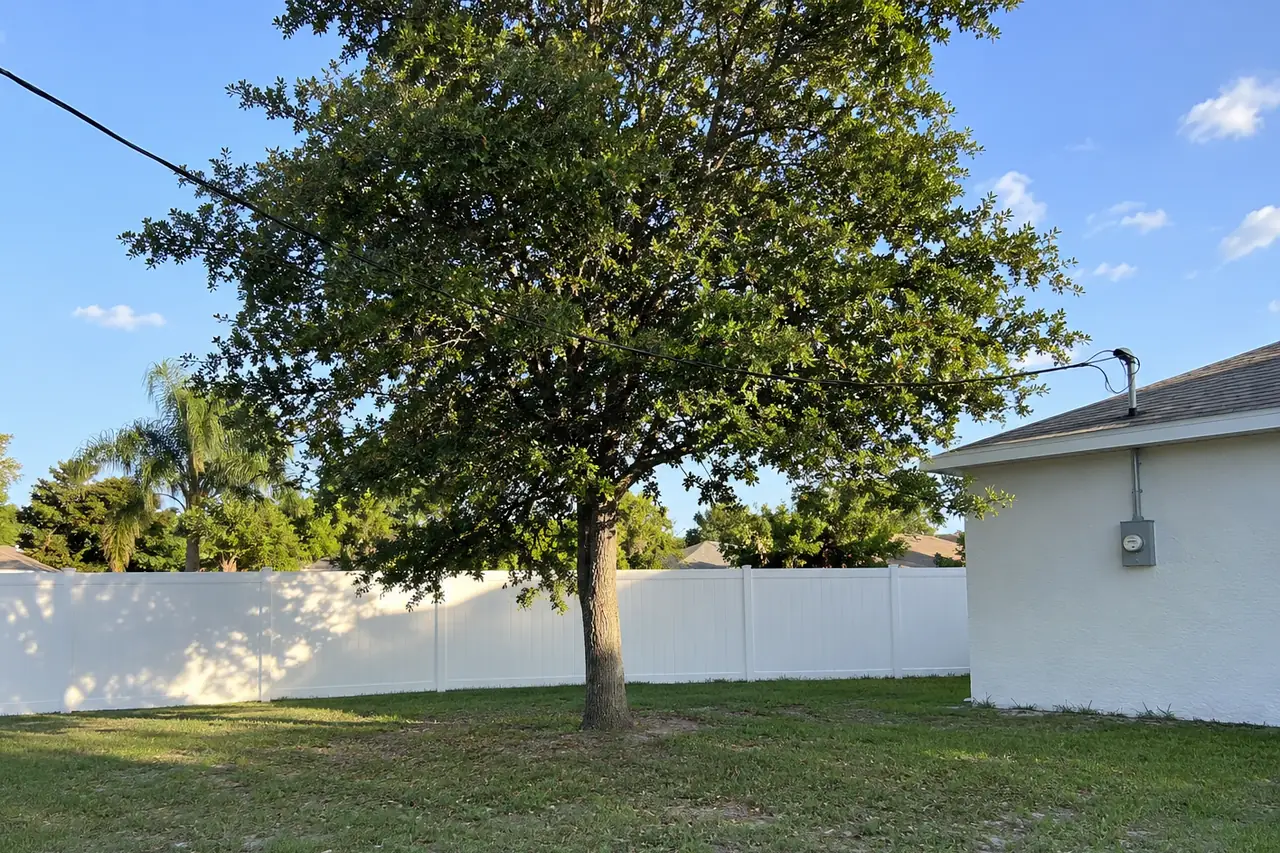
- The service line, or service drop, is the single cable from the nearest pole to the meter on your house. Duke's tree FAQ says the property owner has primary responsibility for keeping it clear of trees and vegetation.
So an oak limb rubbing the cable that runs to your house is yours to deal with, while a limb growing into the lines along the street is the utility's.
What does Duke Energy do, and what does it ask of you?
From Duke Energy's trees and rights-of-way FAQ (checked Nov 17, 2026):
- Main lines: Duke trims on a scheduled cycle, prioritized by reliability data and field conditions. If you report a tree threatening a main line, Duke says a vegetation management professional will follow up within 10 business days.
- Don't do it yourself: "Pruning trees around power lines should only be attempted by qualified professionals," and Duke discourages customers from working around power lines and electrical equipment.
- De-energizing your service: if you or a contractor will work near your service line, Duke asks you to contact it to have the line de-energized before any tree work, and says it doesn't bill for that.
- Distance: citing OSHA and the ANSI Z133 tree-care safety standard, Duke says "an unqualified person should not work within 10 feet of overhead power lines" when the voltage is below 50,000, and the distance grows at higher voltages.
- After storms: "we do not clean up tree debris that results from severe weather."
The 10-foot figure is the one to remember. A pole saw or an aluminum ladder easily reaches 10 feet.
What about Withlacoochee River Electric Cooperative?
WREC's service area began in Citrus, Hernando and Pasco counties. Its member Welcome Book (revised May 2025, checked Nov 17, 2026) says:
- Trees are "the leading cause of power outages on WREC's system," the Welcome Book says.
- Members should never trim, prune or remove trees near power lines; that work belongs to professional tree crews.
- Members should contact their local Cooperative office before removing or trimming a tree near WREC lines.
- If a gate on the right-of-way has a code, provide it to WREC so crews can reach the lines.
Your power bill tells you which utility you have.
What if a tree or limb is already on a line?
Stay away from it and from anything it touches, including a fence or wet ground, and call the utility's outage number. Don't try to pull a limb off a line with a rope or pole. A tree tangled in a primary line is the utility's to clear or de-energize first. Once the line is safe, removing the rest of the tree from your yard is ordinary tree work.
Where should new trees go?
- WREC recommends that trees and shrubs not be planted within 50 feet of overhead lines, especially trees that grow taller than 25 feet.
- UF/IFAS advises choosing wind-resistant species and planting them "away from utilities and structures" (UF/IFAS, checked Nov 17, 2026).
- Before digging a planting hole, contact Sunshine 811 at least two full business days ahead so buried lines get marked (Sunshine 811, checked Nov 17, 2026). WREC's book also says to call 811 forty-eight hours before you dig.
A small tree under a line now is a trimming problem every few years later. Laurel oaks, which UF/IFAS describes as fast-growing, are a poor fit near wires; a smaller-maturing tree well off to the side is the better choice.
What should you ask a tree contractor about line clearance?
- Will they arrange the de-energizing with Duke (or check with WREC) before starting?
- How will they keep people and tools at least 10 feet from the lines they aren't allowed to work near?
- If a limb could fall onto the service line, how will it be lowered?
- Is cleanup of the cut wood included?
For a price on trimming around your service line, call (727) 428-8818 or send a request. Prices for trimming by height are on the tree trimming page.
A tree or palm on your mind?
Call or send a short request. One independent contractor who works New Port Richey and west Pasco picks it up, looks at the tree in person and gives you the price.