
Tree Removal in New Port Richey, FL
Short answer
Removing a tree at a New Port Richey, FL home usually costs somewhere in the $385 to $1,070 range that Lawn Love's 2026 guide gives as typical nationwide (average $850, checked Nov 17, 2026), and inside city limits it generally needs the city's tree removal permit first. What moves the price most here is the tree's height, what sits under it (roof, carport, screened lanai, pool cage, wires) and how a crew gets equipment into the yard.
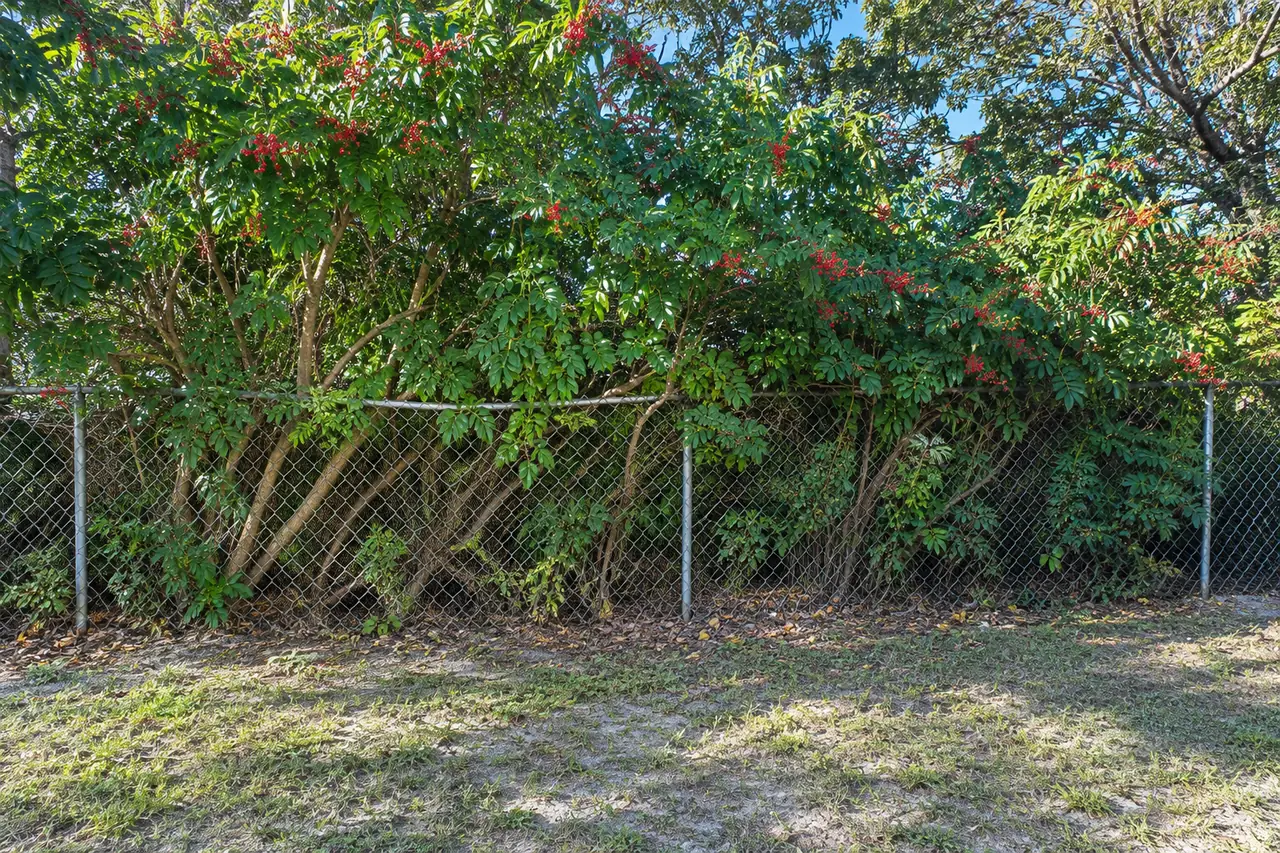
The trees that come down most often in west Pasco are aging laurel oaks, storm-damaged pines, palms with incurable disease, and Brazilian pepper that has taken over a fence line. Each one has its own reasons and rules, laid out below.
Which trees are New Port Richey homeowners taking out?
Laurel oak
The University of Florida's laurel oak fact sheet is blunt about this tree. It grows fast, it's "susceptible to breakage," its trunks and large limbs "often hollow from decay," and its life span is 50 to 70 years. Even a small wound or a bad pruning cut, the sheet adds, can start a column of rot running up the inside of the trunk (UF/IFAS ENH-707, revised Dec 2018, checked Nov 17, 2026). In UF's hurricane surveys, laurel oak landed in the lowest wind-resistance group.
Laurel oak and live oak get mixed up easily. A UF/IFAS Pinellas County extension post lays out the differences: live oak leaves are "thick and leathery with smooth edges," while laurel oak leaves are "smooth, narrow, shiny." Live oaks sprawl, with a spread of 60 to 120 feet; laurel oaks hold a "fairly symmetrical oval canopy." Live oak bark is far rougher than laurel oak's. Live oak acorns are "shiny, dark brown, elongated"; laurel oak acorns are "more of a dull brown" and rounded. Live oaks can live "300 years or more" with wood "quite resistant to decay," the post says (UF/IFAS, Dec 4, 2020, checked Nov 17, 2026). That's why a healthy live oak is often worth keeping where a hollow laurel oak of the same size is not.
Brazilian pepper
UF/IFAS says "it's against the law to sell or purposefully plant Brazilian peppertrees" in Florida, and it warns that the leaves and sap can irritate skin (UF/IFAS Gardening Solutions, checked Nov 17, 2026). Its recommended control is to cut the plant down and treat the stump with herbicide.
Pines
Slash and longleaf pines sit in UF's medium-low wind-resistance group. In UF's Hurricane Ivan data, 72% of slash pines and 59% of longleaf pines survived (UF/IFAS FR174, checked Nov 17, 2026). A dead or dying pine standing over a roof is worth having looked at before the next storm rather than after it.
Palms
A palm showing Ganoderma conks at the base or the late stages of lethal bronzing can't be saved, and UF/IFAS says to remove it. The palm trees page covers both diseases.
What signs say a tree should come out?
A tree that leans a little has often grown that way for decades. These are the signs worth a closer look, drawn from UF/IFAS guidance:
- Hollows and decay in the trunk or large limbs, especially on laurel and water oaks.
- Cracks in branches or the trunk. UF/IFAS's hurricane-prep advice says cracked branches should be removed or shortened.
- Two equal trunks rising from one point (codominant stems), which UF/IFAS describes as a weak point at the base.
- Damaged roots. UF/IFAS notes that any tree is more likely to topple in a storm if construction has damaged its roots. A new driveway, pool or sewer line cut beside a big oak counts.
- Dead branches over the roof, driveway or play area. UF/IFAS's hurricane-prep page says dead branches that can fall on houses, cars and people should be removed.
From UF/IFAS Preparing Trees for Hurricanes and ENH-707, checked Nov 17, 2026.
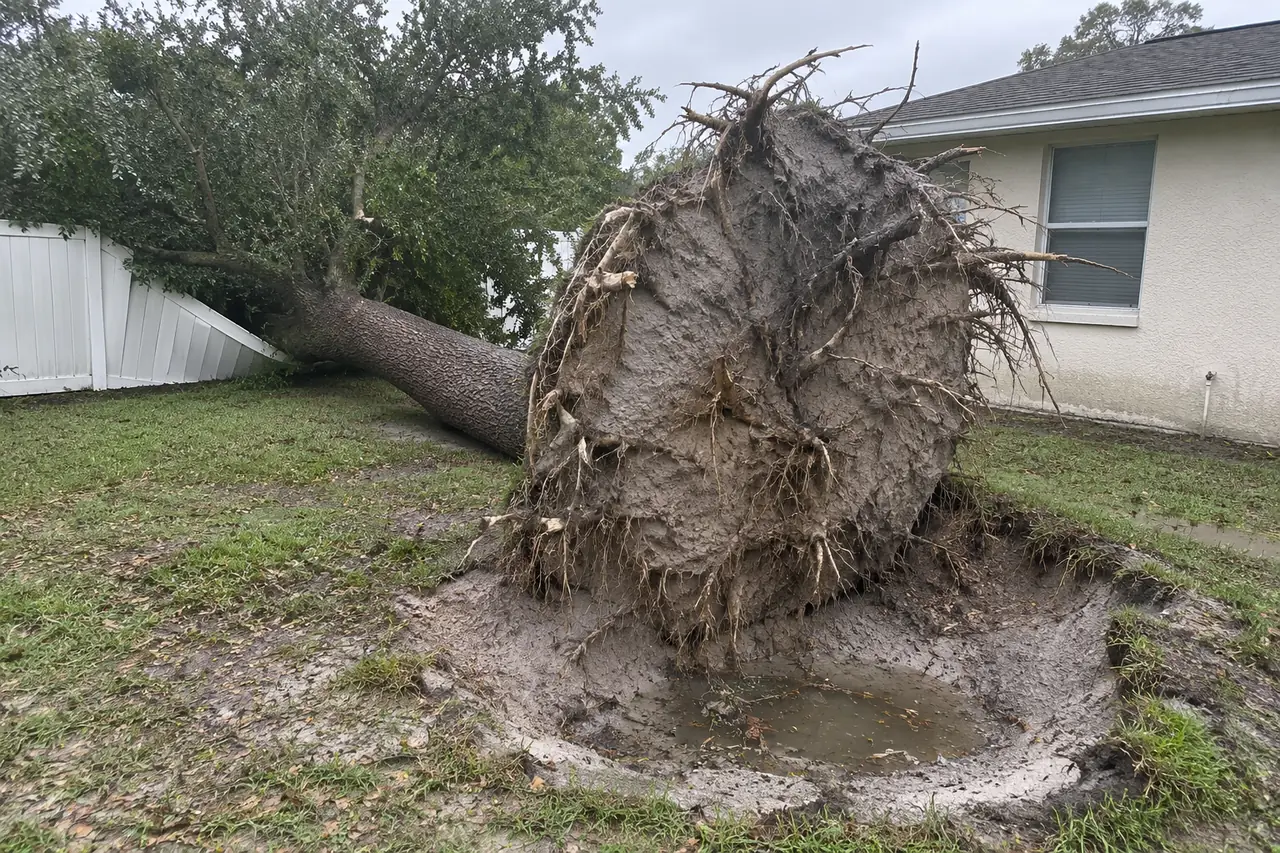
What does a toppled tree look like in sandy soil?
When an oak goes over in west Pasco sand, the roots usually come up as one wide, fairly thin disk with gray sand packed into it, standing on edge beside a shallow, saucer-shaped hole. That plate is heavy and under tension. Cutting the trunk loose can let the stump and root plate rock back toward the hole, which is one of the reasons a toppled tree is handled by someone with the right gear. The cleanup usually means cutting the trunk into sections, grinding or setting the root plate back, and filling and leveling the hole with sand or fill.
Which permit rules apply to your lot?
| Jurisdiction | Short version |
|---|---|
| City of New Port Richey | Permit for removing or relocating a tree 4 inches or more across; nine invasive species exempt; replacement minimums on house lots. Details |
| City of Port Richey | City FAQ says no permit to remove a tree, but an arborist's letter for protected trees, most often oaks. Details |
| Unincorporated Pasco | Permit for trees 5 inches DBH and larger; palms and pines other than longleaf exempt on single-family lots; exotic and invasive species exempt. Details |
In all three, Florida's section 163.045 lets a single-family owner with a signed onsite risk assessment from an arborist or a landscape architect, showing the tree poses an unacceptable risk, prune or remove it without local permits, fees or replanting.
How is a tree taken down on a small west Pasco lot?
On a typical small lot with a house, a carport and a screened lanai or pool cage in back, there's seldom room to drop a big tree whole. The usual approach is to remove the crown and trunk in pieces, lowering heavy sections on ropes or lifting them out with a bucket truck or crane where the truck can reach. Brush goes through a chipper parked at the curb, which blows the chips straight into an enclosed chip truck. The trunk is cut into pieces that can be carried or loaded.
A few things to settle before the work starts:
- Whether the price includes hauling away the wood and the chips, and whether it includes the stump.
- Where the truck will park, and whether anything under the lawn, such as a septic drain field or irrigation lines, needs to be kept clear of heavy equipment.
- Gate width into the backyard, and whether a fence panel has to come off.
- Which of your neighbor's things are under the canopy.
Can the city haul the wood away?
Not usually, for a whole tree. The City of New Port Richey's yard debris program wants limbs cut under 6 feet long, trunks no more than 8 inches across, and debris left unbagged and untied. It says the program is for "typical property maintenance by homeowners and residents," not land clearing, and the city works through town over a 6 to 8 week cycle (city yard debris page, checked Nov 16, 2026). In Port Richey, the city's brush page says businesses doing yard work must haul away what they generate. For a removal, plan on the contractor taking the wood.
What does tree removal cost by size?
| Tree height | Typical price |
|---|---|
| Up to 30 ft | $285 to $435 |
| 30 to 60 ft | $435 to $870 |
| 60 to 80 ft | $870 to $1,160 |
| Over 80 ft | $1,160 to $2,000 |
| Emergency removal | $450 to $3,000 |
| Stump removal, added | $180 to $525 |
Source: Lawn Love tree removal cost guide. Inside the city, add the permit fee and any replacement tree or tree fund payment. More on the tree service cost page.
A tree or palm on your mind?
Call or send a short request. One independent contractor who works New Port Richey and west Pasco picks it up, looks at the tree in person and gives you the price.