
Tree Trimming in New Port Richey, FL
Short answer
Trimming a tree at a New Port Richey, FL home typically runs $412 to $612 per tree, with small trees as low as $80 and very large ones up to $1,840, according to Lawn Love's 2026 trimming guide (checked Nov 17, 2026). The University of Florida's extension service advises having any tree taller than about 15 feet pruned by an arborist before hurricane season, with dead branches removed and cracked ones removed or shortened.
Below: what a good storm-season trim takes out and leaves in, why laurel oaks need careful cuts, the topping rule in unincorporated Pasco, and how prices change with height.
What should a pre-hurricane trim take out?
UF/IFAS's Preparing Trees for Hurricanes page (checked Nov 17, 2026) is the clearest local-relevant guide, and its list is short:
- Dead branches that could fall on houses, cars or people.
- Cracked branches, which should be removed or shortened.
- Weak structure on young trees. UF/IFAS describes codominant stems, two trunks of about equal size growing from one point, as a weak spot, and recommends training young trees toward "a sturdy, well-spaced framework of healthy branches along a dominant trunk."
It also suggests having large trees looked at about every two years. Timing matters in practice. Lawn Love's trimming guide notes that tree services are busiest after major storms, so a trim scheduled in the quiet months is easier to book and gets the dead wood out before the wind finds it.
What a pre-storm trim should not do is strip the inside of the canopy bare or cut the top off. Those cuts leave a tree with long, bare limbs carrying all their weight at the tips, and on species that decay easily they open the wood to rot.
Why do laurel oaks need careful pruning?
On laurel oak, UF/IFAS cautions that a minor trunk wound or one poorly placed pruning cut can lead to decay spreading in a column inside the trunk (ENH-707, checked Nov 17, 2026). Laurel oak is fast-growing, rated "susceptible to breakage," and in UF's wind studies it falls in the lowest group for hurricane resistance. That combination means two things for a homeowner:
- Cuts should be made just outside the branch collar, the slightly swollen ring where a limb meets the trunk, not flush with the trunk and not leaving a long stub.
- On an older laurel oak, the trimming visit is also the time to look for hollows, fungus at the base and cracks. Past a certain point, trimming a hollow laurel oak only buys time, and taking it down is the safer job. The tree removal page has the warning signs.
Live oaks are the opposite case. UF/IFAS puts live oak in its highest wind-resistance group, with 91% still standing after Hurricane Ivan in its study, so a well-pruned live oak is usually worth the care.
What about limbs over the roof, lanai or pool cage?
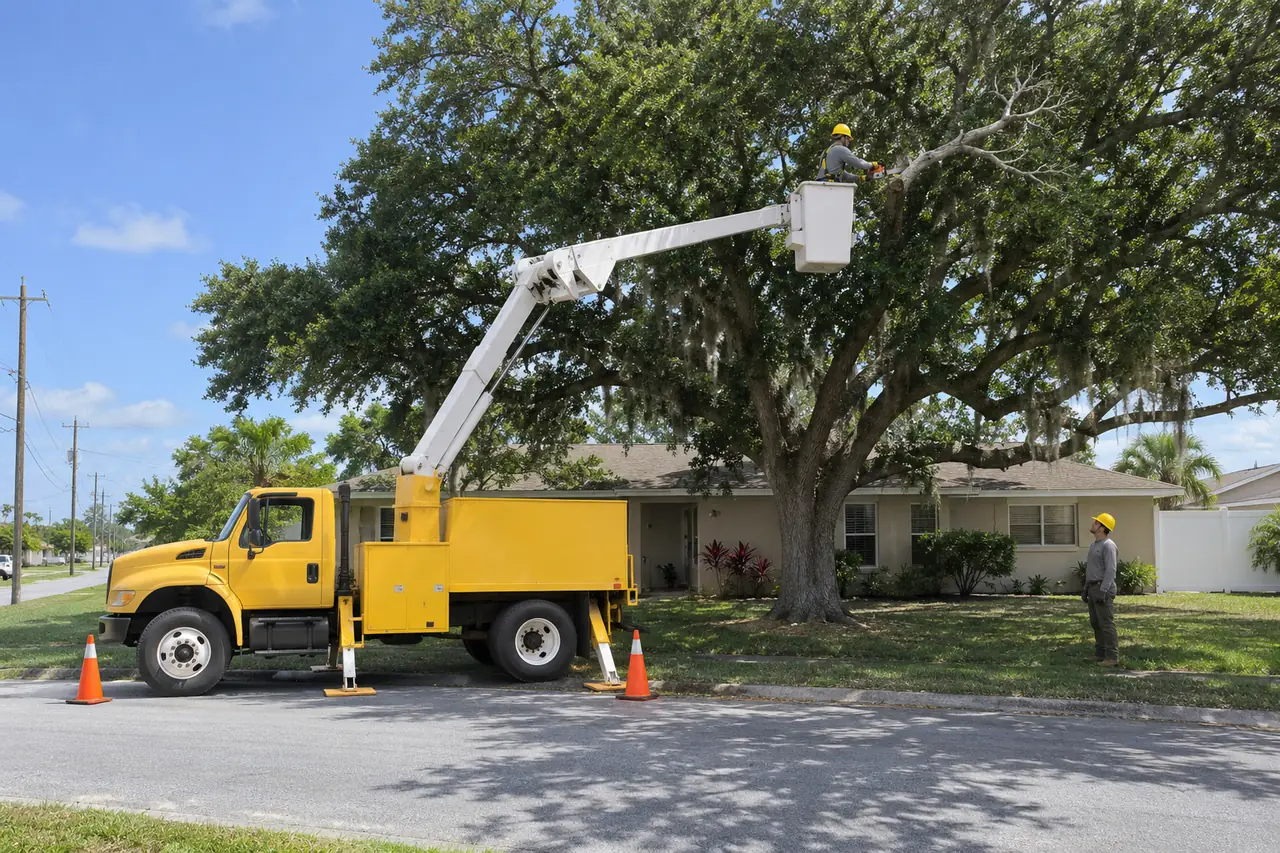
Where an oak has grown out over a one-story roof, or a young tree has been planted close to a pool cage, the problem builds slowly. Limbs touching a roof scrub shingles in every breeze and drop leaves into gutters. Limbs over a screened lanai or pool cage put the aluminum frame and screen in the path of anything that falls.
The common fix is to shorten those limbs back to a smaller side branch growing away from the house, which keeps the tree's shape and avoids leaving stubs. Ask whoever prices the job how much clearance they plan to leave over the roof and how they'll protect the lanai screen while working above it.
Is topping a tree allowed?
In unincorporated Pasco County, the county's tree code (Section 802.8.E, as adopted by Ordinance 26-08 on March 24, 2026) lists topping and improper pruning among prohibited activities, and says separate violations may be charged "for each inch of the tree measured at DBH" (code text via Zoneomics, checked Nov 17, 2026). That covers Holiday, Trinity, Elfers, Jasmine Estates and Hudson. Inside the City of New Port Richey, its tree protection section, City Code 8.02.00, is the place to check.
Apart from the rules, topped trees tend to sprout a mass of fast, weakly attached shoots from the cut ends, which are easy for wind to tear off later.
Are palms and wires handled differently?
Yes. Palms are pruned on different principles: UF/IFAS says to remove only fully brown fronds and calls the common "hurricane cut" harmful. See the palm trees page.
For limbs near power lines, Duke Energy's guidance is that pruning near lines should be done only by qualified professionals, and it will de-energize your service line on request before tree work. The trees near power lines page explains who handles which wire.
Do you need a permit just to trim?
The City of New Port Richey's tree permit application is written for removing or relocating a tree; its Development Permits page (checked Nov 16, 2026) does not describe a separate pruning permit. Heavy pruning that amounts to topping is a different matter in the county, as above. And Florida's section 163.045 covers pruning and trimming as well as removal: a single-family owner with a signed risk assessment of the type the statute describes can't be required to get local approval for it.
What does trimming cost by tree height?
| Tree height | Per tree |
|---|---|
| Under 30 ft | $80 to $420 |
| 30 to 60 ft | $210 to $790 |
| Over 60 ft | $470 to $1,840 |
| Palm trees | $100 to $1,330 |
Source: Lawn Love tree trimming cost guide. The guide adds that prices may rise for a while after big storms. Hauling the cut limbs, a backyard with no truck access and limbs over a structure all add to the price. See tree service cost for the rest.
A tree or palm on your mind?
Call or send a short request. One independent contractor who works New Port Richey and west Pasco picks it up, looks at the tree in person and gives you the price.