
Palm Tree Service in New Port Richey, FL
Short answer
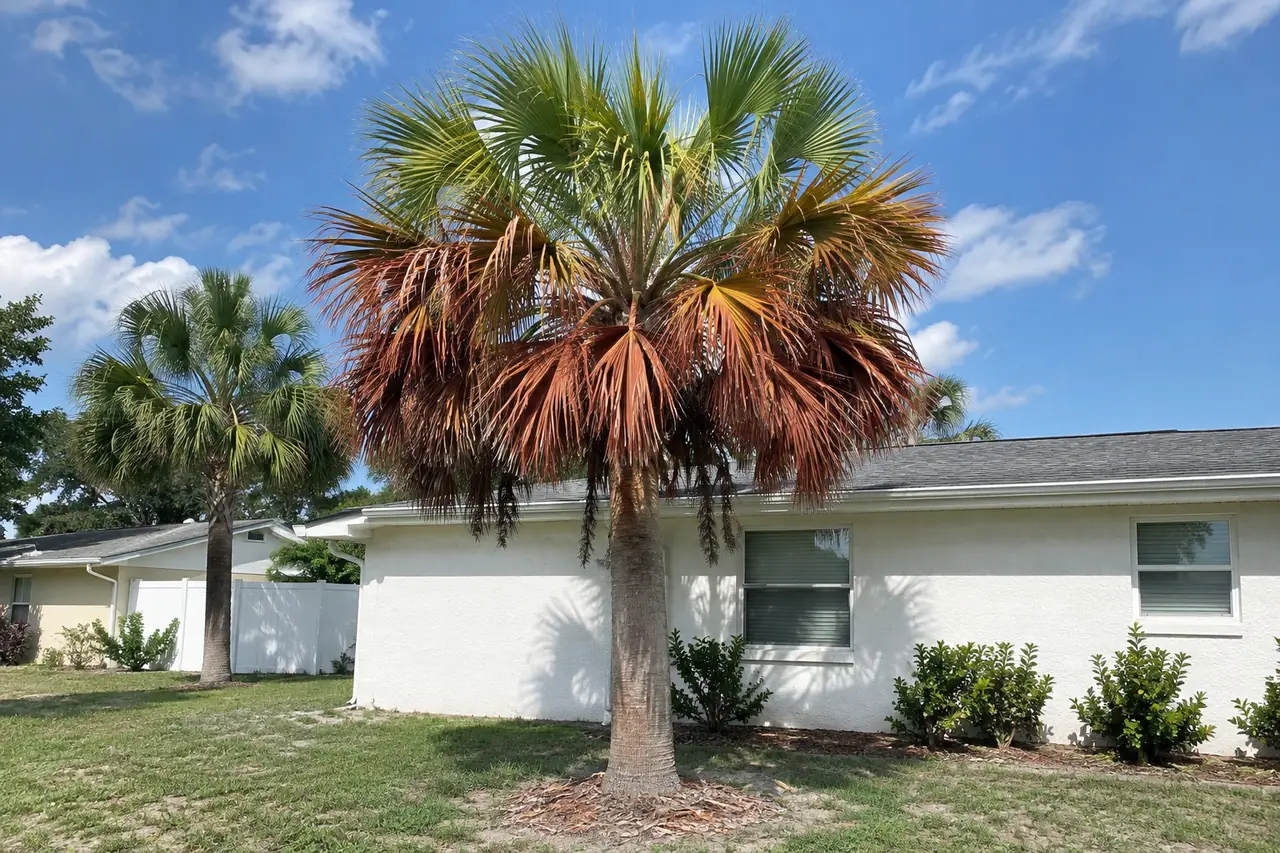
Palm work in New Port Richey, FL comes down to three things: lethal bronzing, which UF/IFAS lists as confirmed in Pasco County; Ganoderma butt rot, which has no cure; and pruning, where UF/IFAS says to remove only fully brown fronds and calls the "hurricane cut" harmful (all checked Nov 17, 2026). Lawn Love's 2026 guides put palm trimming at $100 to $1,330 per tree and removal of a 30 to 50 foot palm at $310 to $475.
A palm that's dying from either disease can't be brought back, and the sooner it's identified, the sooner the palms around it can be protected or tested.
What is lethal bronzing, and is it in Pasco?
Lethal bronzing is a fatal palm disease caused by a phytoplasma, which UF/IFAS describes as "a type of bacteria that lacks a cell wall." It used to be called Texas Phoenix Palm Decline. UF/IFAS's fact sheet says it has been confirmed in 36 Florida counties, including Pasco, Hillsborough (where it was first found, in the Tampa area), Pinellas and Manatee (UF/IFAS PP163, last modified Aug 28, 2025, checked Nov 17, 2026).
It has been found in 21 palm species, including the ones west Pasco yards are full of: cabbage palm (sabal palm), queen palm, Canary Island date palm, edible date palm and coconut palm.
Symptoms, in order
- Fruit drops early, if the palm is fruiting. If it isn't, the flower clusters die (UF/IFAS calls them necrotic).
- The oldest fronds discolor first, and the discoloration moves up into the younger ones.
- The spear leaf, the single unopened frond at the very top, collapses. UF/IFAS says this final stage means the palm can't be saved.
What can be done
- Symptomatic palms: once symptoms show, UF/IFAS says the antibiotic's label rate "is not sufficient for symptom reversal," so it says to remove them immediately.
- Healthy-looking palms nearby: UF/IFAS recommends testing them, and removing any that test positive.
- Protecting healthy palms: injections of oxytetracycline HCl every three to four months, for at least two years, can be used as a preventive on healthy palms near infected ones.
What is Ganoderma butt rot?
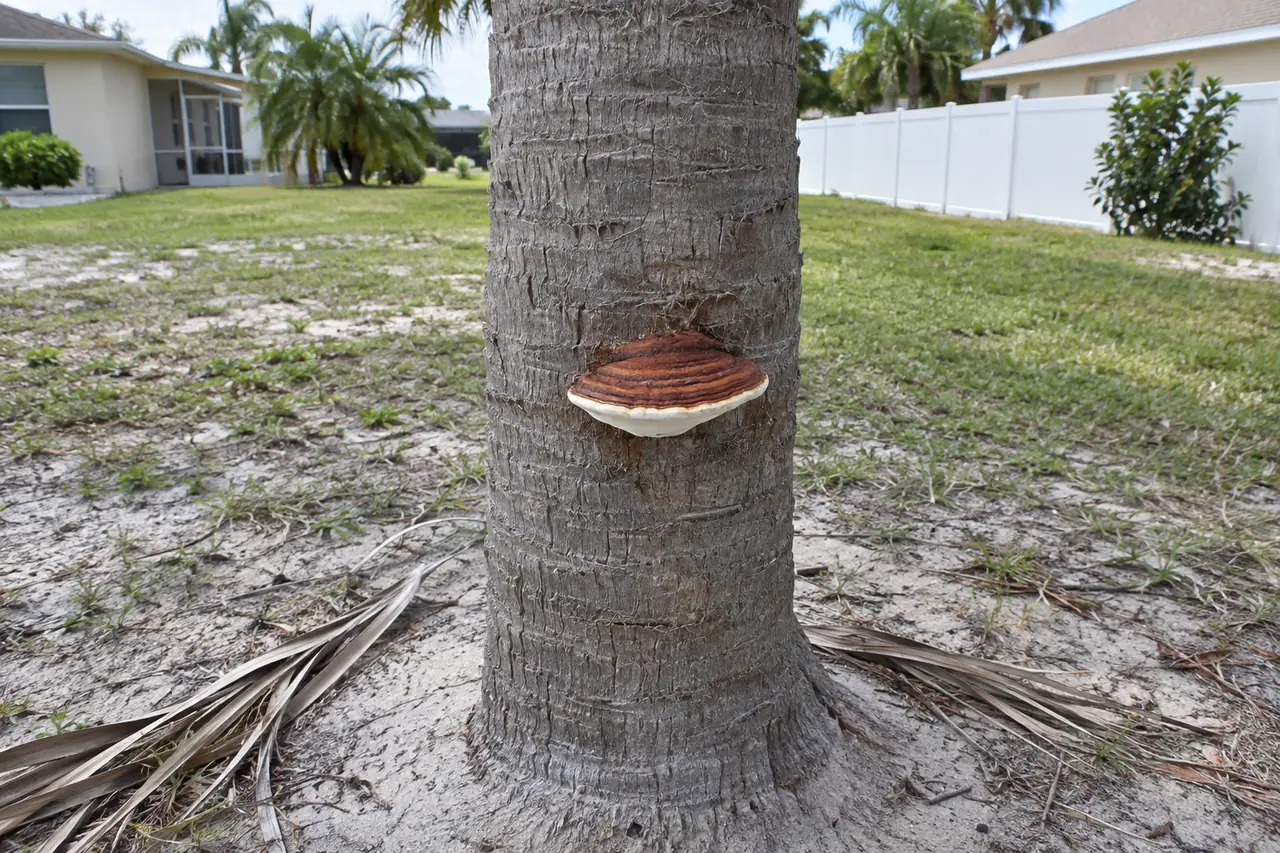
Ganoderma butt rot is a fungal disease, caused by Ganoderma zonatum, that decays the lower 4 to 5 feet of a palm's trunk. UF/IFAS considers all palms susceptible and has documented it in at least 65 species (UF/IFAS PP100, checked Nov 17, 2026).
The clearest sign is a conk: a hard, shelf-like growth attached directly to the trunk, reddish-brown on top and white underneath. UF/IFAS cautions that "many diseased palms do not produce conks prior to death." Earlier signs it lists include "wilting, mild to severe, of all leaves except the spear leaf," off-color foliage and slower growth, though those alone don't confirm the disease.
The fact sheet is plain about the outlook. There are "no cultural or chemical controls for preventing the disease," and no effective cure once a palm is infected. Its advice:
- Remove the palm as soon as conks appear, "primarily for safety reasons"; these palms are "likely to be the first blown down in heavy winds."
- Remove as much of the stump and roots as possible, or grind the stump.
- Avoid putting another palm in the same spot. UF/IFAS says "replanting with another palm is risky" and calls any plant except a palm "a wise choice."
- Send the infected lower trunk to a landfill or have it burned. Don't use it as mulch.
- Check your other palms every six months, or monthly once you've seen conks or lost a palm to the disease.
Does the "hurricane cut" protect a palm?
No. UF/IFAS calls the practice, cutting a palm back to a tight tuft of fronds at the top, "unfortunately common in Florida and harmful to palms." It says the hurricane cut "actually makes trees less able to withstand hurricane-force winds," and that after storms, "hurricane-cut palms were more likely to have their crowns snapped off by the wind" (UF/IFAS Pruning Palms, checked Nov 17, 2026).
The same page's rules for palm pruning are simple:
- Remove only fronds that are fully brown.
- Never remove live, green, healthy fronds.
- Leave yellowing or half-dead fronds. They can be a sign of a nutrient problem, and cutting them hides the symptom needed to diagnose it.
- Never use climbing spikes on a palm; they damage the trunk.
UF/IFAS also notes that repeated over-pruning can shrink leaf size and trunk diameter over time. A neat-looking palm with only a few fronds left is a weaker palm.
How do cabbage palms hold up in storms?
Very well, as a rule. In UF/IFAS's review of hurricane data, sabal (cabbage) palm survival stayed between 80% and 100% across six hurricanes, and 99% of the experts surveyed rated it high for wind resistance (UF/IFAS FR174, checked Nov 17, 2026). That's one reason a full-crowned cabbage palm is worth keeping, and one reason stripping its fronds works against it. The exception is a palm with Ganoderma conks at the base, which UF/IFAS says is likely to be among the first blown down in heavy winds.
Do you need a permit to remove a palm?
- Unincorporated Pasco (Holiday, Trinity, Elfers, Hudson): the county's tree code exempts any palm on a single-family lot, unless it's part of an adopted replanting or landscape plan. See Pasco County tree rules.
- City of New Port Richey: the city's tree removal application treats palms as trees. It lists a palm within 5 feet of a structure as one of its removal reasons, and on commercial property the tree fund rate for palms is $25 per inch. See the city permit page.
- City of Port Richey: see Port Richey.
What does palm work cost?
| Job | Range | Source, checked |
|---|---|---|
| Palm trimming, per tree | $100 to $1,330 | Lawn Love, Nov 17, 2026 |
| Palm removal, 30 to 50 ft | $310 to $475 | Lawn Love, Nov 17, 2026 |
| Stump grinding, per job | $131 to $438 | LawnStarter, Nov 17, 2026 |
A diseased palm can add steps: the lower trunk from a Ganoderma palm has to go to the landfill rather than into mulch, and its stump should be ground out. Grinding is covered on the stump grinding page.
A tree or palm on your mind?
Call or send a short request. One independent contractor who works New Port Richey and west Pasco picks it up, looks at the tree in person and gives you the price.